

The majority of framing work on industrial sites is performed using two channel profiles. The mistake of selecting the incorrect profile typically manifests itself months later in the form of a re-drilled anchor pattern or sag in a pipe run. Unistrut P5001 and P5000 both belong to the standard 1-5/8 inch channel family, yet they answer different structural questions. One carries loads that a single channel cannot. The other keeps installations light and quick where the demand is moderate. This comparison walks through where each one earns its place, and how load, space, and site conditions push the decision one way or the other.
What are Unistrut P5001 and P5000?
P5000 is the base 1-5/8 inch by 1-5/8 inch channel, 12 gauge, with the familiar continuous slot along one face that accepts nuts, brackets, and fittings anywhere along the length. Unistrut P5000 handles most general framing, light equipment supports, and cable management runs.
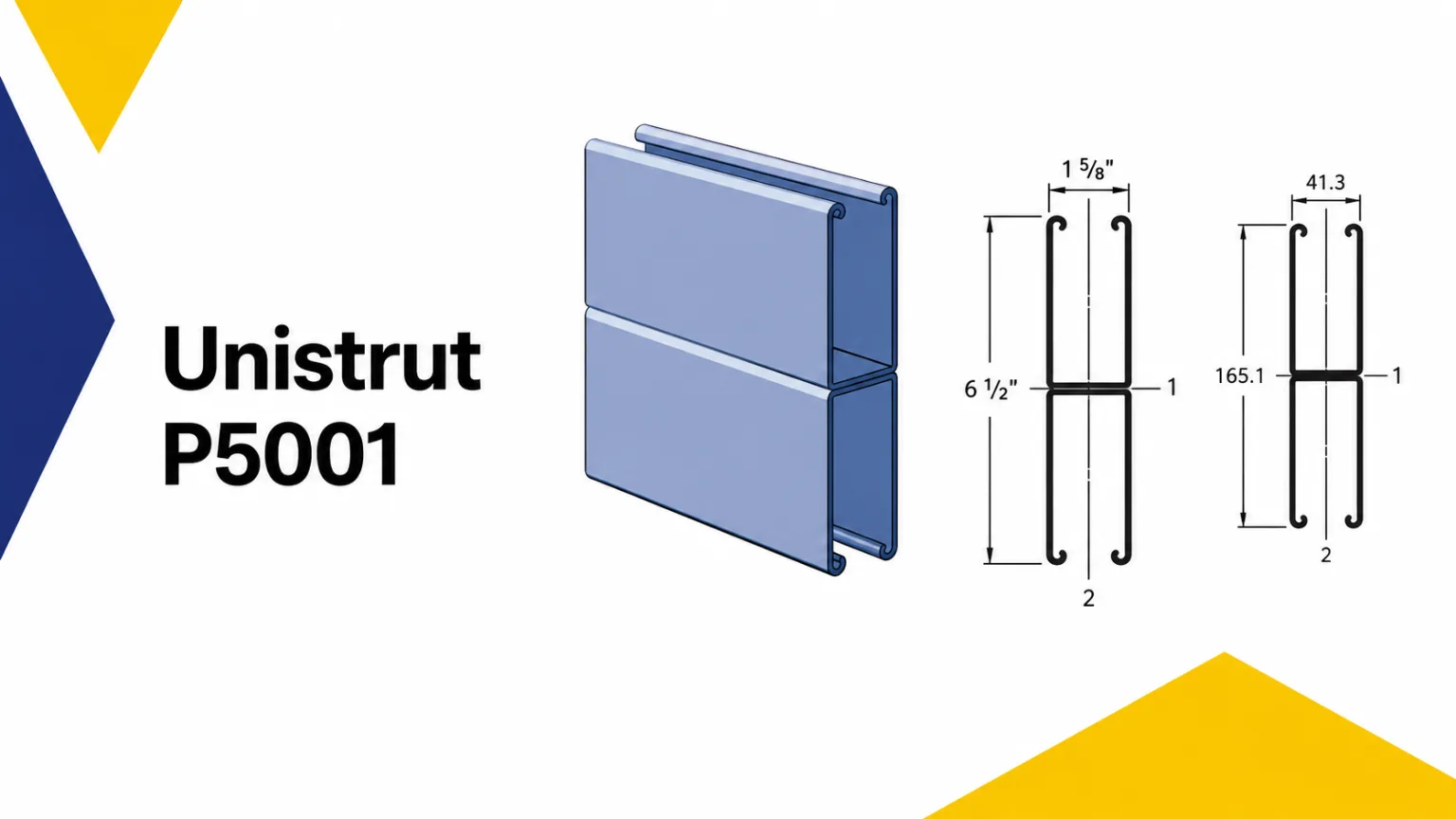
P5001 takes that same profile and welds two channels back to back, giving a 1-5/8 inch by 3-1/4 inch section with slots facing both directions. Contractors reach for it on pipe racks, trapeze hangers spanning long bays, and structural bracing where a single channel bends before it should.
Unistrut P5001 vs P5000: Key Differences
Channel Design
P5000 runs as a single roll-formed section with one open face. P5001 joins two of those sections at their closed backs through intermittent welds, producing a closed box-style profile. That welded pair resists twisting far better under eccentric loads, which matters when a bracket hangs off one side and pulls the channel out of plane.
Strength and Load Capacity
Doubling the section depth roughly triples the moment of inertia, so P5001 carries heavier uniform loads across the same span. Deflection drops sharply. On a 10-foot simple span, a single channel starts to sag under loads that P5001 absorbs without visible movement, which is why pipe racks, chiller supports, and multi-tier trapeze assemblies default to the double section.
Dimensions and Profile
Both share the 1-5/8 inch slot width, so fittings interchange freely. Depth is the split: 1-5/8 inch for P5000, 3-1/4 inch for P5001. That extra 1-5/8 inch of depth eats the ceiling void and shaft clearance. In tight plenums or crowded riser shafts, the single channel often wins on fit alone, even when strength calculations favour the double.
Installation and Support Requirements
Standard channel nuts, spring nuts, and P1000 series fittings work on both. P5001 weighs close to double per foot, so crews handling long lengths overhead usually need two people or a lift. Anchor spacing tightens as well, since the heavier section transfers more dead load into each fixing point. Cutting P5001 also takes longer because the saw passes through two walls at every cut.
Common Applications
P5000 suits cable tray hangers, small conduit runs, light HVAC ductwork supports, and modular equipment frames. P5001 belongs on pipe racks carrying filled process lines, seismic bracing members, rooftop solar substructures, and any span above roughly 8 feet where deflection limits govern. Where the load calculation sits near the limit of a single channel, moving up removes the guesswork.
Material and Finish Options
Plain steel works indoors in dry, conditioned spaces. Pre-galvanized and hot-dip galvanized finishes cover damp interiors and exterior work respectively, with hot-dip giving the thicker zinc layer for coastal or roof-mounted service. Stainless Steel Unistrut P5001 in 304 or 316 goes into chemical plants, food processing floors, wastewater facilities, and marine environments where chloride exposure attacks zinc coatings within a few years.
Comparison Table
| Factor | P5000 | P5001 |
| Design | Single channel | Two channels welded back to back |
| Depth | 1-5/8 in | 3-1/4 in |
| Strength | Standard | Substantially higher stiffness |
| Load capacity | Light to moderate | Heavy, long spans |
| Typical use | Cable trays, conduit, light HVAC | Pipe racks, seismic bracing, solar |
| Best when | Space is tight, loads modest | Deflection or load governs |
Which Unistrut Channel Should You Choose?
Start with the load, not the catalogue. Total the weight of pipes when full, cable bundles at final fill, plus any equipment hung from the run, then check it against the published span and deflection tables for the support spacing you can actually achieve on site. If the single channel clears the requirement with margin, use it. Available depth decides the next step, because a 3-1/4 inch section will not fit every ceiling void. Environment settles the finish: chloride exposure, washdown chemicals, or coastal air push the specification toward 316 stainless, where the higher upfront cost avoids replacing corroded supports within five to seven years.
Applications of Unistrut P5001 and P5000
HVAC supports split by duct weight, with light branch ducts on P5000 and main plant room runs on the double section. Cable tray installations follow the same logic, though tray widths above 600 mm and multi-layer stacks generally call for P5001. Pipe supports depend on filled line weight and span, so a 50 mm chilled water line runs fine on a single channel while a 200 mm header does not. Solar mounting structures and seismic bracing members go to P5001 almost without exception, since both carry dynamic loads that single channel resists poorly. Industrial framing mixes the two, using the heavier section as the primary skeleton.
Choosing a Reliable Unistrut P5001 Supplier
Check that the material carries mill test certification and that the channel meets the dimensional and gauge requirements of the relevant Unistrut specification. Ask for the finish designation in writing, since pre-galvanized and hot-dip galvanized differ in coating thickness and service life. A capable Unistrut P5001 Supplier holds 10-foot and 20-foot lengths across plain, galvanized, and 304 or 316 stainless finishes rather than ordering everything on demand. Stock depth shortens project timelines. Confirm cutting, punching, and fabrication capability too, because site-cut galvanized channels need cold galvanizing on exposed edges.
Conclusion
P5001 doubles the section, roughly triples stiffness, and carries the loads that flatten a single channel across long spans. P5000 stays lighter, fits tighter voids, and covers the majority of general framing and support work at lower cost. Load magnitude, span, available depth, and corrosion exposure decide between them, and running those four checks before ordering prevents most field problems. For pipe racks, seismic bracing, and heavy support duty, specify the double channel. Contact Robexstrut to confirm stock lengths and finishes for your project.

Vikram Rao is an experienced Unistrut Product Specialist, who has worked in this field for more than 20+ years. His metal frame system and support structure knowledge has been quite helpful in creating creative ideas for building projects all around.
See Full Bio ›