

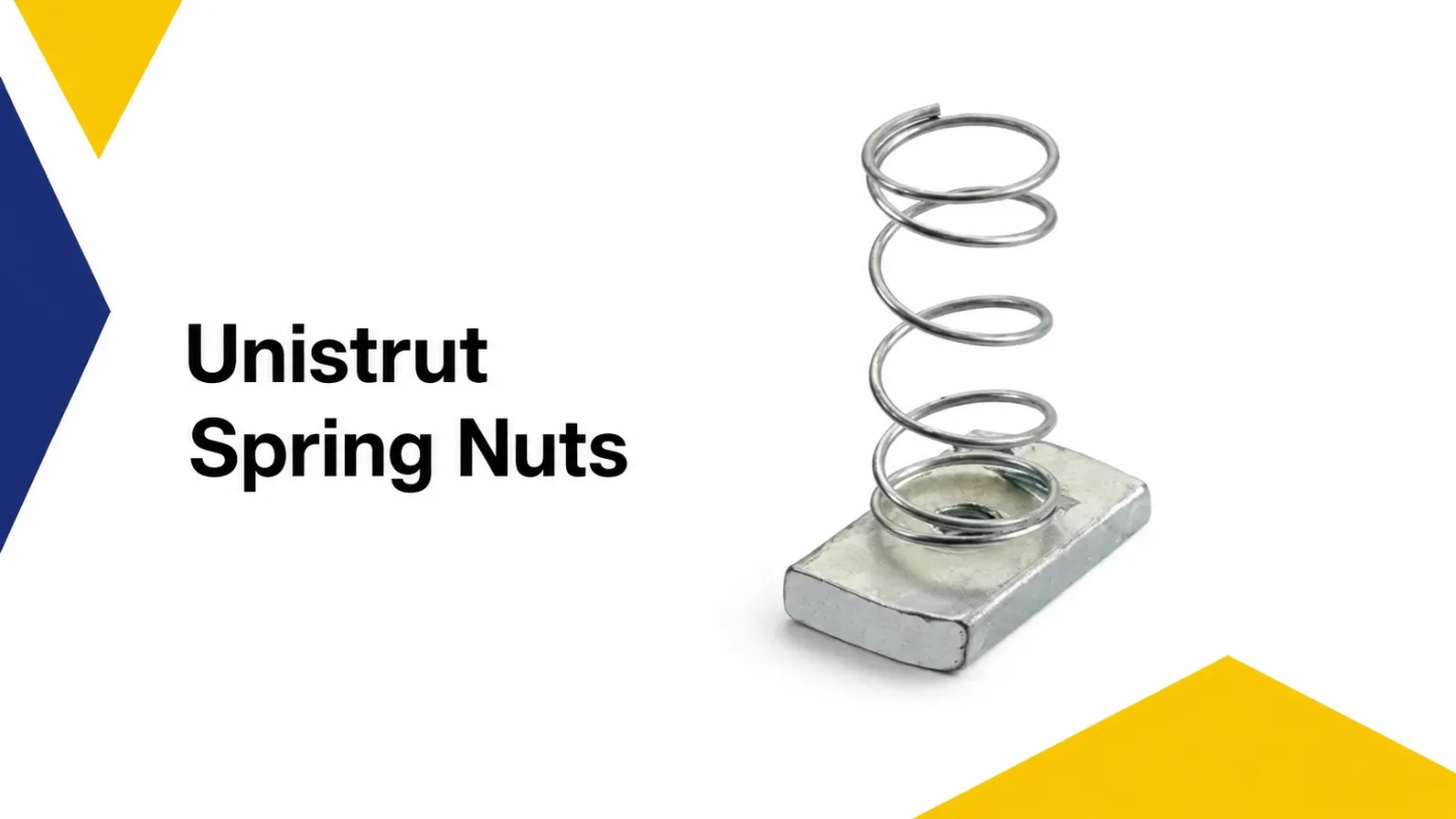
Installing an incorrect spring nut in a strut channel can cause brackets to work loose over time. Unistrut spring nuts remove this risk by providing a precise, secure fit. Unistrut spring nuts hold bolts and threaded rods inside the strut channel. The functional benefit of a spring nut is completely reduced if the size is incorrect, as channel profiles vary in depth, lip opening, and gauge thickness. This blog discusses selecting the correct spring nut for each channel specification.
What are Unistrut Spring Nuts?
A spring nut is a channel nut fitted with a curved spring clip that pushes against the interior lips of the channel. The spring holds it in place while a bolt or threaded rod is started when you drop it in at an angle and turn it 90 degrees. Installers use them with framing bolts, threaded rod for hangers, and clamp-style fittings. Typically, they are carbon steel with an electro-galvanized or hot-dip finish, or in stainless steel for wet and corrosive locations. Unistrut spring nuts are sized to specific channel series.
Why Channel Size Matters When Selecting Spring Nuts?
Channel depth and lip width set the clearance required for the spring nut. A nut sized for a 1-5/8 inch deep channel will rock or bind inside a 13/16 inch mini channel. Fit determines how the load transfers from bolt to nut to channel wall. Loose engagement concentrates stress on a smaller contact area and raises the chance of slippage under vibration. Correct sizing also speeds up installation, since crews on cable tray or HVAC runs handle hundreds of these connections in a single shift, and a nut that seats on the first try saves real labor hours across that volume.
Identify the Channel Series
Confirm the channel profile in use first, whether that’s standard 1-5/8 inch single or double channel or shallower mini channel. Cross-reference the series number against the manufacturer’s fitment chart before ordering.
Choose the Correct Thread Size
The tapped thread of the nut corresponds to the bolt or rod already specified, commonly 1/4-20, 3/8-16, or 1/2-13. Heavier fixtures and longer cantilevers call for the larger thread, since a mismatched thread strips under torque instead of clamping down.
Check Spring Length and Design
Spring nuts come in short-spring and long-spring versions. Long-spring designs suit deeper channel, where the nut travels further before locking against the lips, and that extra travel makes one-handed installation on overhead runs easier.
Consider Load Requirements
Look at the actual pulled or sheared load that the connection will see. Standard spring nuts are commonly rated between 1,000 and 2,000 pounds of axial load, depending on thread size and channel gauge. Build in a margin above the calculated load so the connection tolerates movement or shock, not just the number on paper.
Select the Right Material and Finish
Hot-dip galvanized nuts suit outdoor and industrial atmospheres. Stainless steel handles washdown areas, coastal sites, and chemical plants where galvanizing won’t hold up. In stainless assemblies, the spring itself is often formed from 17-7PH precipitation-hardened stainless steel, chosen because that alloy keeps its spring temper after the aging treatment that gives it corrosion resistance. A plain austenitic spring loses tension faster under repeated flexing.
Verify Compatibility with Accessories
Confirm the nut’s thread and body width work with the brackets, beam clamps, or pipe hangers on order, and check that washer diameters clear the channel lip without binding.
Review Manufacturer Specifications
Pull the dimensional drawing and load table for the part number. Tolerances on spring travel and thread depth vary between manufacturers even for the same nominal channel size.
Common Mistakes to Avoid
Fitting a spring nut to the wrong channel depth is the most frequent error on site, caught only after the bolt won’t seat flush. Mismatching the thread size to the bolt already in hand strips the threads under the first real torque. Skipping the load calculation means the supports are underrated for the fixture they carry. Choosing carbon steel for a washdown or coastal application shortens service life sharply. Ignoring bracket and washer clearance rounds out the list, forcing rework after the run is assembled.
Applications of Unistrut Spring Nuts
Cable tray systems rely on spring nuts to anchor hangers along long horizontal runs without a second installer underneath. Pipe supports in mechanical rooms use the same principle for threaded rod drops. HVAC, electrical support systems, and solar mounting structures use them to fix brackets to channel at repeated intervals across a roof or wall. Industrial framing adds them wherever equipment needs a bolted connection into a channel that isn’t pre-drilled.
Choosing a Reliable Channel Spring Nuts Supplier
Check the supplier’s stocked range across channel series, thread sizes, carbon steel and stainless finishes before committing to one source. Ask for documentation confirming compliance with the load and material standards the specification calls for. Stock availability matters as much as catalogue breadth. A supplier who lists a part but takes six weeks to ship it isn’t useful on a job with a fixed date. Technical support that can confirm fitment against an unfamiliar profile saves a costly ordering mistake before it happens.
Conclusion
Getting the spring nut right comes down to matching channel series, thread size, spring length, and material to the load and environment the assembly will face. Skipping any one of those checks tends to surface later, as a loose connection or a corroded nut rather than a clean install. Sourcing from a Channel Spring Nuts Supplier that stocks verified parts and backs them with technical support, such as Robexstrut, keeps that selection straightforward and the finished support system reliable for the long run.

Vikram Rao is an experienced Unistrut Product Specialist, who has worked in this field for more than 20+ years. His metal frame system and support structure knowledge has been quite helpful in creating creative ideas for building projects all around.
See Full Bio ›