

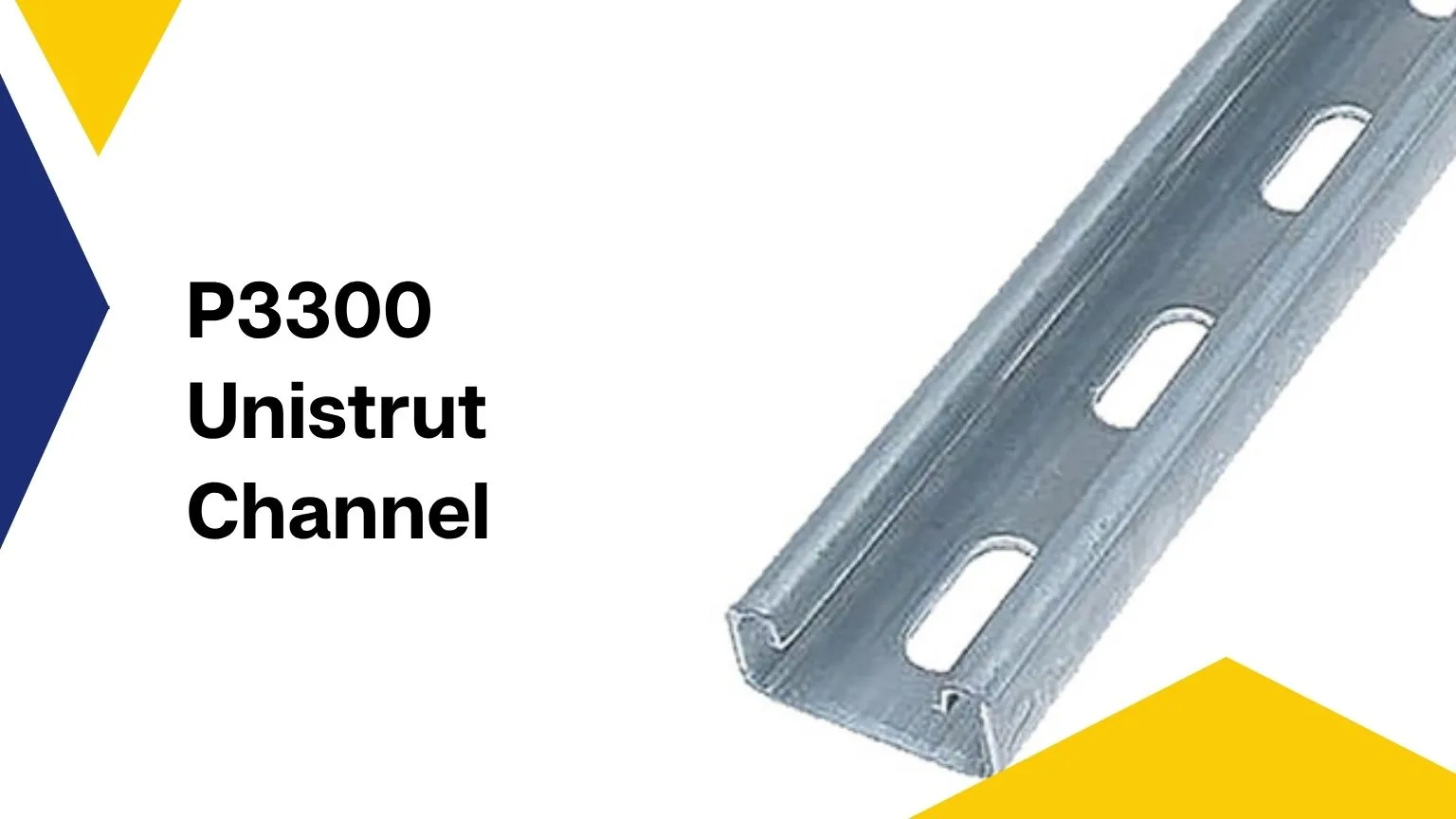
Every conduit run, cable tray, and HVAC line needs a frame strong enough to hold its weight for decades, not just past the first inspection. The P3300 unistrut channel has become a standard choice for supporting electrical conduits, cable trays, HVAC systems, piping, and structural frameworks across commercial and industrial sites. Getting the selection right means weighing load requirements, material, finish, and application together. This guide provides a detailed explanation of how to select the appropriate metal framing P3300 channel for a given application.
What Is a P3300 Unistrut Channel?
A P3300 Unistrut channel is a cold-formed steel framing member with a continuous slotted profile, built to accept spring nuts and fittings without drilling or welding. The channel measures 1-5/8 inches by 1-5/8 inches in its standard profile, with wall thickness ranging from 12 gauge to 14 gauge, depending on load class. Finish options include pre-galvanized, hot dip galvanized, powder coated and stainless steel. Structural strength depends on gauge thickness and finish integrity, so a channel rated for indoor use will underperform if installed outdoors without correct corrosion protection.
Key Features of P3300 Strut Channel
These features explain why engineers specify this profile across electrical and structural projects.
- High load-bearing capacity supports heavy conduit runs and equipment racks without deflection.
- Easy and flexible installation lets crews assemble frameworks on site using bolted connections instead of welding.
- Excellent corrosion resistance comes from galvanized or stainless steel finishes suited to harsh environments.
- Compatible with a wide range of accessories, allowing fittings to attach at any point along the slot.
- Durable and low maintenance construction reduces the need for repainting or structural rework.
- Suitable for indoor and outdoor applications makes one profile usable across an entire facility.
- A reusable and adaptable framing solution allows sections to be reconfigured as layouts change.
Factors to Consider When Choosing the Right P3300 Unistrut Channel
Six variables determine whether a channel performs correctly once it carries real load in the field.
- Load-bearing requirements must match the combined weight of conduits, cables or equipment.
- The choice of materials used is based on the strength requirements and the exposure of the site for steel, stainless steel and aluminium.
- The protection provided by standard galvanizing or stainless steel is dependent on the corrosion resistance and environment in which the product will be used.
- The deflection limits of channels under point or distributed loads are influenced by channel dimensions and thickness.
- In humid or chemical service, coatings and surface finishes are important.
- Check installation needs and accessories prior to ordering to prevent a mismatch in the fittings.
- When the installation meets project specifications, it stays in line with engineering and code requirements.
Types of Unistrut P3300 Channels
Each variant serves a distinct purpose depending on load direction, accessory needs, and site exposure.
Plain P3300 Unistrut Channel
Plain channel has no slotting along its length, giving maximum rigidity for straight runs where accessory points are not required.
Slotted P3300 Channel
Slotted channel runs continuous slots along one or more faces, letting fittings attach anywhere along the length without pre-drilling.
Half-Slotted P3300 Channel
Half-slotted channel combines a solid face for strength with a slotted face for accessory mounting, useful where both matter.
Pre-Galvanized P3300 Channel
Pre-galvanized channel is zinc coated before forming, it provides reliable indoor corrosion resistance at lower costs than hot dip processing.
Hot Dip Galvanized P3300 Channel
Hot Dip Galvanized Channel is dipped in zinc after fabrication, which creates a thicker protective layer for outdoor environments.
Stainless Steel P3300 Channel
Stainless steel channel resists corrosion in chemical processing plants and coastal facilities where galvanized coatings degrade faster.
Applications of P3300 Unistrut Channel
The same profile supports a wide range of building systems once matched to the correct load class and finish.
Electrical support systems
Conduit runs across commercial and industrial facilities rely on Unistrut P3300 Channel to keep wiring organized and protected.
Cable tray installations
The channel is used in data centers and process plants to support cable trays at certain fixed, secure heights.
HVAC duct and pipe supports
A strut channel mounts the ductwork and refrigerant lines for adjustable support to accommodate thermal expansion.
Plumbing support structures
Water and drainage piping runs along strut framing in mechanical rooms, replacing welded pipe hangers.
Solar panel mounting systems
Ground-mount and rooftop solar arrays use P3300 Strut Channel as racking, since its slotted profile accepts standard clamps.
Industrial equipment support
Machinery bases and control panels mount on strut framing for vibration-resistant, reconfigurable support.
Warehouse shelving and framing
Storage racks and mezzanine framing use the channel for its reusability as inventory needs shift.
Commercial and residential construction
Building services throughout offices and apartment complexes rely on strut channels to route conduit, cable, and piping.
Common Mistakes to Avoid When Selecting a P3300 Channel
Selecting the wrong load rating causes sagging or failure once a channel carries its full design weight, and this remains the most frequent specification error on site. Ignoring environmental conditions leads to premature rust on channels installed outdoors with only pre-galvanized coating. A wrong finish or poor accessory match can mean costly rework halfway through. Some teams don’t plan for future expansion and size their runs to just fit the current load, only to face retrofit costs later. Considering solely based on price, rather than long-term performance, often costs more when replacement is factored in.
Benefits of Using P3300 Strut Channel
Beyond individual features, these advantages explain why the profile remains a standard across support system specifications.
- Reduced labor hours due to quicker installation and assembly than welded or drilled structures.
- The benefits of reduced fabrication costs are that there is no welding performed onsite and no custom bracket manufacturing.
- Flexible modifications and adjustments allow for moving fittings without cutting or replacing sections.
- Under constant loading, strong and reliable support maintains the stability of conduits, trays and equipment.
- Long service life reduces the frequency of structural replacement across a building’s lifespan.
- This has an excellent corrosion protection that can last throughout the life of a channel in environments with high humidity, coastal areas and chemical exposure.
- Lower maintenance costs follow from finishes that resist rust and wear without repainting.
Conclusion
Choosing the right P3300 Unistrut Channel comes down to matching load class, material, and finish to the actual conditions a project will face, not just its budget line. Strength, flexibility, corrosion resistance, and broad accessory compatibility make this profile suited to electrical, mechanical, and structural work across industries. Robexstrut supplies these channels for teams that need a support system built to hold up under long-term site conditions. Selecting the correct specification from the outset improves installation efficiency and keeps the structure reliable for years of service.

Vikram Rao is an experienced Unistrut Product Specialist, who has worked in this field for more than 20+ years. His metal frame system and support structure knowledge has been quite helpful in creating creative ideas for building projects all around.
See Full Bio ›